AI-era development
How UltiPad built itself: 30+ features shipped by a coding agent
UltiPad is developed inside UltiPad. Ideas become specs, a coding agent builds them over MCP, and every commit reports back — 3,028 AI-written lines, counted commit by commit.
30+
features shipped by the loop
3,028
AI-written lines, counted
35
MCP tools the agent uses
Most AI coding demos start with a clean repo and a toy prompt. Ours starts with a product backlog — because UltiPad is planned, specced, and largely built inside UltiPad, by a coding agent connected over MCP.
The loop looks like this: a one-line idea is filed (by a human, or by the agent itself mid-build). Within seconds UltiPad drafts user stories, acceptance criteria, and a functional spec. A human reviews and approves an agent spec — the machine-readable contract. The agent pulls that spec over MCP, implements it, and reports back over the same wire: progress comments, commits with diff stats, stories checked off, the workflow stage moving on its own.
Measured, not vibes
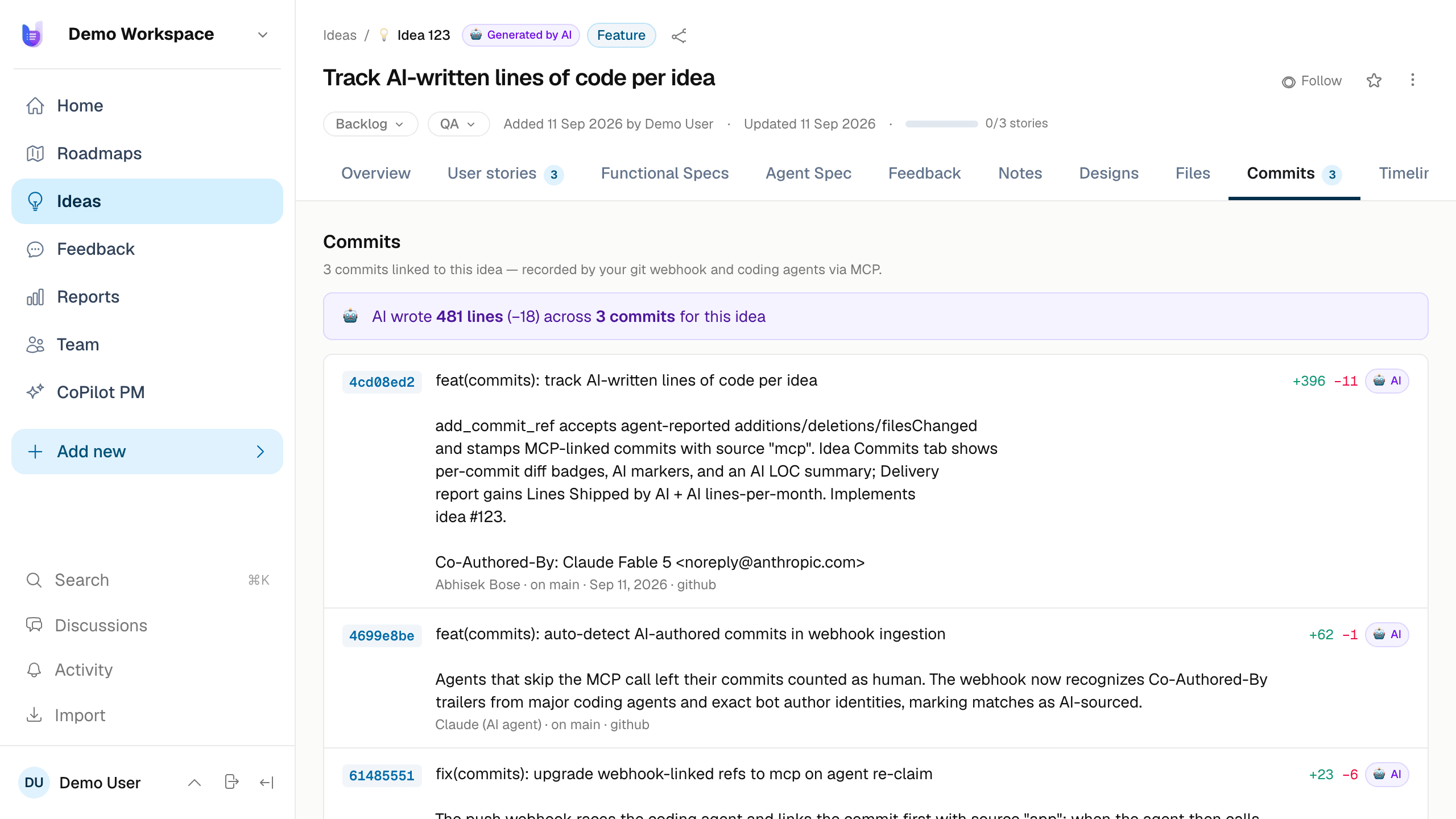
The part teams ask about most: attribution. Every commit an agent records carries its additions and deletions, and commits are stamped by source — agent or human. That means the question "what did the AI actually do?" has a number: at the time of writing, 3,028 lines of AI-written code across the features in this workspace, visible per idea ("AI wrote 481 lines across 3 commits") and rolled up in the Delivery report.
There's even a guard for the race condition we hit ourselves: the git webhook usually sees a commit before the agent reports it. When the agent then claims the same commit with its stats, UltiPad upgrades the attribution instead of double-counting — a fix that was, naturally, specced and shipped through the same loop it improves.
The reverse direction is the differentiator
Agents don't just consume the backlog — they feed it. When our agent discovers work mid-build (a missing endpoint, a permissions gap), it files the idea itself over MCP. The idea arrives badged as agent-created and gets the same auto-documentation as a human one. Zero copy-paste, zero status meetings.
This is what we mean by ADLC — the Agent Development Life Cycle. Not a chatbot bolted onto a PM tool, but a loop where product context flows to the agent and delivery evidence flows back, in both directions, automatically.
Try the same loop
One command connects any MCP client — Claude Code, Cursor, Codex — to your workspace with per-user API keys (reviewer keys are read-only). Your agent reads the objective, the customer evidence, and the acceptance criteria before it writes a line — then the lines it writes are counted.
Run this loop on your own product.
We're onboarding teams in waves — join the waitlist and we'll open your workspace.
Join the waitlistRead next
Anatomy of one idea: the ADLC from first sentence to counted delivery
Idea #123 in our workspace, replayed station by station: auto-drafted stories, an approved agent spec, three agent commits totalling 481 lines, and a stage that moved itself to QA.
A user reported a missing API at breakfast. It was in production by lunch.
An external user hit a documented endpoint that didn't exist. The report became an idea, the idea became a spec, an agent built it — deployed, rate-limited, and verified the same day.