AI-era development
Anatomy of one idea: the ADLC from first sentence to counted delivery
Idea #123 in our workspace, replayed station by station: auto-drafted stories, an approved agent spec, three agent commits totalling 481 lines, and a stage that moved itself to QA.
3
user stories drafted in seconds
481
AI-written lines on this one idea
0
status updates typed by a human
The best way to explain the Agent Development Life Cycle is to replay a real idea. Idea #123 in our own workspace — "Track AI-written lines of code per idea" — went from one sentence to delivered feature with every step recorded on the idea itself. Here is its actual timeline.
Station 1 — the idea documents itself
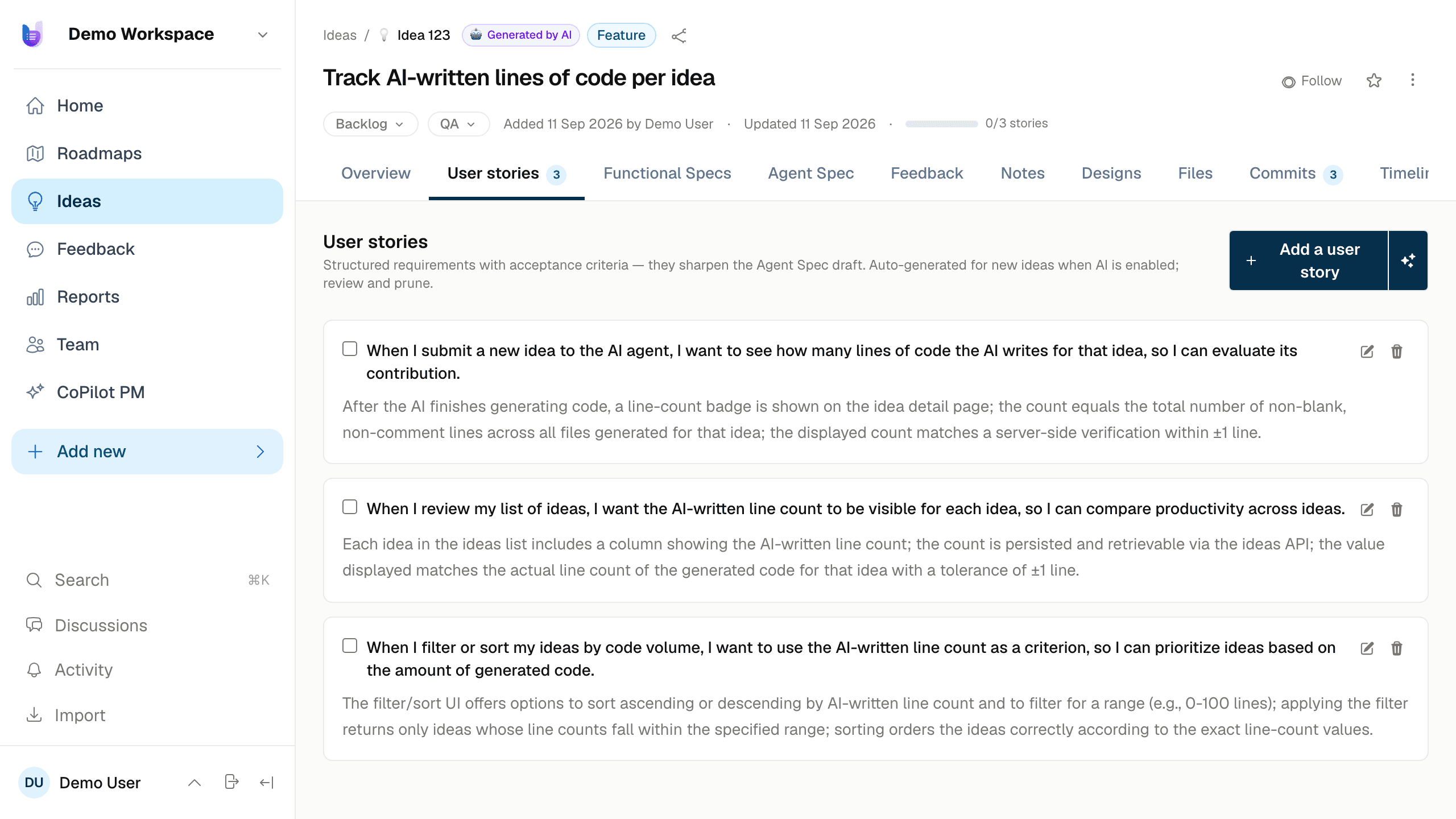
The idea was filed with a short description of the problem. Within seconds, UltiPad drafted three user stories with acceptance criteria ("When I review my list of ideas, I want the AI-written line count visible for each idea, so I can compare productivity across ideas") and a functional spec covering the data model, the tool changes, and the reporting surfaces. Nobody wrote a PRD. The meeting that would have produced one never happened.
Station 2 — the agent spec is the contract
A human approved the approach — one decision, made once: line counts would be agent-reported from git's own diff stats rather than fetched from a provider API. That decision became the agent spec: machine-readable, human-approved, and the exact contract the coding agent builds against. This is the trust boundary of the ADLC — agents never act on vibes, only on approved specs.
Station 3 — build, and the wire runs both ways
The agent pulled the spec over MCP and reported "started" — which moved the idea's workflow stage to In Progress automatically. Then came the commits, each recorded against the idea with its diff stats: +396/−11 across 12 files for the core feature, +23/−6 for a race-condition fix, +62/−1 for webhook auto-detection. Total: 481 AI-written lines on this idea, visible as a summary strip on its Commits tab.
That middle commit is worth pausing on. During rollout we discovered the git webhook usually records a commit before the agent can claim it — stealing the attribution. The agent filed the problem, fixed it (an agent re-claiming a webhook-linked commit upgrades its attribution and back-fills the stats), and shipped it through the same loop. The lifecycle debugged itself.
Station 4 — delivery is a state, not a status report
When the agent reported "completed", the idea moved itself to QA for human verification, the spec status updated, and the delivery rolled up into the reports: the funnel counts it, the AI-contribution chart adds its 481 lines, and the owner's delivery scorecard credits it. Every claim in this article is checkable on the idea's own page — which is the point of the ADLC: the audit trail is the workflow.
Run this loop on your own product.
We're onboarding teams in waves — join the waitlist and we'll open your workspace.
Join the waitlistRead next
How UltiPad built itself: 30+ features shipped by a coding agent
UltiPad is developed inside UltiPad. Ideas become specs, a coding agent builds them over MCP, and every commit reports back — 3,028 AI-written lines, counted commit by commit.
A user reported a missing API at breakfast. It was in production by lunch.
An external user hit a documented endpoint that didn't exist. The report became an idea, the idea became a spec, an agent built it — deployed, rate-limited, and verified the same day.